About Friction Slide Apparatus
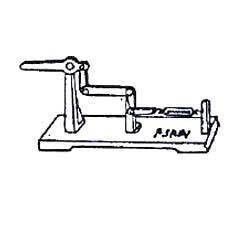
Friction Slide Apparatus
It is veryinteresting to study different laws of friction with it. Comprising of a 75x15cm. wooden board and a frictionless pulley at one end, a scale pan with thefollowing accessories but without weights.
1. One set of three wooden carriageswith different bottom surface (Wood, glass and iron).
2. One carriage with frictionlessrollers.
3. One set of three differentsurfaces for friction board-a glass plate, a plywood and felt cloth.
Comprehensive Study of Friction LawsThis apparatus empowers students and educators to practically explore both static and dynamic friction. The included sliding blocks and pulley system allow for direct, tangible demonstrations, making the laws of friction more accessible and understandable. Clear scale graduations support accurate data collection during experiments.
Durable and User-Friendly DesignCrafted with corrosion-resistant materials and a powder-coated finish, the Friction Slide Apparatus is built for prolonged laboratory use. Its manual operation and hand-controlled mechanisms ensure reliability, while the included instruction manual provides step-by-step guidance for setup and experiments, making it suitable even for beginners.
FAQ's of Friction Slide Apparatus:
Q: How do you use the Friction Slide Apparatus in a laboratory setting?
A: To use the apparatus, place the sliding block on the friction surface, attach weights to the hanger, route the string over the pulley, and incrementally add weights until the block moves. The reading at which the block slides allows you to calculate the coefficient of friction, helping visualize frictional principles.
Q: What types of friction experiments can be demonstrated with this apparatus?
A: The apparatus is designed for demonstrations of both static and dynamic friction. Its accessories enable users to compare friction between different materials (steel and wood) and measure how force requirements evolve as an object transitions from rest to motion.
Q: When should you perform maintenance on the Friction Slide Apparatus?
A: This apparatus requires very little maintenance. Periodic cleaning of the sliding surface and pulleys, combined with inspection for dust or debris, is generally sufficient to keep it in optimal working condition.
Q: Where is the Friction Slide Apparatus best utilized?
A: It is best suited for use in educational laboratories-such as schools, colleges, and universities-where hands-on physics experiments are a core part of the curriculum. It is also valuable for technical training institutes and research setups focusing on classical mechanics.
Q: What are the main benefits of using this friction apparatus for educational experiments?
A: The main advantages include high measurement accuracy, a robust and stable construction, ease of operation, and clear metric scale graduations. These features support effective demonstrations of frictional forces, enhancing conceptual understanding for students.
Q: What process should be followed to accurately measure the coefficient of friction using this apparatus?
A: To measure the coefficient of friction, set up the block and weights, gradually add load to the hanger, and note the point where the block starts moving. Divide the hanging mass (force) by the block's mass to calculate the coefficient for static and dynamic friction separately.






 Send Inquiry


 Send Inquiry


 English
 Spanish
 French
 German
 Italian
 Chinese (Simplified)
 Japanese
 Korean
 Arabic
 Portuguese