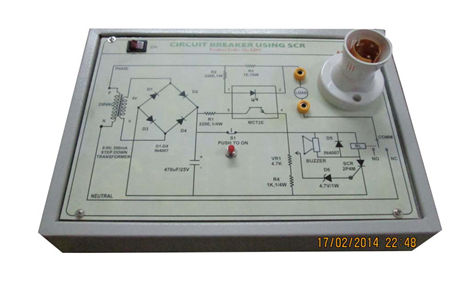
CIRCUIT BREAKER USING SCR

CIRCUIT BREAKER USING SCR

CIRCUIT BREAKER USING SCR Specification

  • Type
  • Circuit Breaker using SCR
  • Material
  • High quality PCB, semiconductor components (SCR), and plastic housing
  • Size
  • Standard module size
  • Input Voltage
  • 220V AC
  • Color
  • Green PCB with black enclosure
  • Dimension (L*W*H)
  • 120 mm x 75 mm x 40 mm
  • Capacity
  • Up to 10A load
  • Noise Level
  • Silent operation
  • Operating Temperature Range
  • -10°C to 55°C
  • Response Time
  • Fast acting within microseconds
  • Protection Feature
  • Overload and short circuit protection
  • Frequency
  • 50/60 Hz
  • Application
  • Power distribution, industrial and laboratory automation
  • Operation Mode
  • Electronic automatic tripping
  • Switching Device
  • Silicon Controlled Rectifier (SCR)
  • Mounting Type
  • Panel mount
  • Compliance
  • Meets IEC safety standards


About CIRCUIT BREAKER USING SCR


Unlock impeccable power protection with our Best-seller CIRCUIT BREAKER USING SCR. Famed for its invincible performance and unbeatable reliability, this device employs a Silicon Controlled Rectifier (SCR) as its switching component for astounding electronic automatic tripping. Experience rapid response within microseconds, providing overload and short circuit protection for your industrial, power distribution, and laboratory setups. Crafted from high-quality PCB and semiconductor materials, this premier panel-mount breaker operates silently between -10C and 55C. Compliant with IEC standards, this standard-sized, green PCB and black housed circuit breaker is your trusted safeguard for up to 10A loads at 220V AC.

Where CIRCUIT BREAKER USING SCR Excels

Trusted by engineers and technicians, this circuit breaker is widely used in power distribution, industrial automation, and laboratory environments. It is specifically designed for managing sensitive electronic equipment and heavy-load machinery. Extra features include a silent operating mode, compliance with stringent IEC safety standards, fast microsecond-level response, and user-friendly panel mounting, making it an ideal solution wherever rapid, reliable protection is paramount.


Supply Chains and Export Markets

Our CIRCUIT BREAKER USING SCR is dispatched promptly upon receipt of a purchase order, ensuring minimal downtime for clients. Securely packaged in durable boxes, it arrives safely at your location. With strong supply ability, we serve both domestic markets and international export hubs. Major export markets include Asia, Africa, and the Middle East, positioning us as a leading choice among distributors, traders, and manufacturers. Reliable logistics make us the supplier of choice worldwide.


FAQ's of CIRCUIT BREAKER USING SCR:


Q: How does the SCR-based circuit breaker enhance protection in industrial applications?

A: The SCR-based circuit breaker ensures rapid and precise response to overloads or short circuits, interrupting electrical faults within microseconds to safeguard connected systems and equipment.

Q: What installation process is recommended for this panel-mount circuit breaker?

A: Install the breaker by securely mounting it onto a compatible panel and connecting the input and output terminals as per IEC guidelines, ensuring it is properly integrated into the distribution network.

Q: When is the circuit breaker most beneficial for users?

A: The circuit breaker is particularly advantageous in scenarios that demand silent operation, microsecond-level reaction to faults, and robust protection for both sensitive and heavy-duty equipment.

Q: Where is this circuit breaker commonly used?

A: It is commonly deployed in power distribution boards, industrial automation panels, and laboratory setups requiring dependable electronic protection.

Q: What are the benefits of its silent operation feature?

A: Silent operation minimizes noise pollution in sensitive environments like labs and industrial control rooms, contributing to a more comfortable and distraction-free workspace.

Q: How does the product meet international compliance standards?

A: It is engineered in compliance with IEC safety guidelines, ensuring its reliability, safety, and acceptance in global markets.

Tell us about your requirement
product

Price:

Quantity
Select Unit

  • 50
  • 100
  • 200
  • 250
  • 500
  • 1000+
Additional detail
Mobile number

Email

More Products in Humidifier Category

MONOSTABLE MULTIVIBRATOR TRAINER (USING 555 IC)

MONOSTABLE MULTIVIBRATOR TRAINER (USING 555 IC)

Size : Standard Laboratory Trainer Size

Capacity : Educational use for demonstration/testing

Input Voltage : 5V to 12V DC

Dimension (L*W*H) : Approx. 27 cm x 17 cm x 6 cm

Color : Green PCB board, Clear/Black housing

Material : High Grade FR4 PCB, ABS/Clear Acrylic Top

DETERMINATION OF MODULUS OF RIGIDITY  OF WIRE BY MAXWELLS NEEDLE

DETERMINATION OF MODULUS OF RIGIDITY OF WIRE BY MAXWELLS NEEDLE

Size : Standard experimental size (needle length approx. 30 cm)

Capacity : Designed for wires of diameter: 0.3 mm to 0.6 mm

Input Voltage : Not required (manual operation)

Dimension (L*W*H) : Approx. 35 cm x 15 cm x 15 cm

Color : Silver (metallic finish)

Material : Stainless Steel body with precision wire

TO DETERMINE OF RESOLVING POWER OF A PRISM FOR PROMINENT LINES OF MERCURY BY SPECTROMETER

TO DETERMINE OF RESOLVING POWER OF A PRISM FOR PROMINENT LINES OF MERCURY BY SPECTROMETER

Size : Standard Laboratory Size

Capacity : Single Prism Specimen Observation

Input Voltage : 220 V AC

Dimension (L*W*H) : Approx. 30 cm x 25 cm x 20 cm

Color : Grey/Metallic with Black Base

Material : Optical Glass and Metal

SPEED CONTROL OF PMDC MOTOR USING SCR FULL WAVE CONTROLLED RECTIFIER TRAINER

SPEED CONTROL OF PMDC MOTOR USING SCR FULL WAVE CONTROLLED RECTIFIER TRAINER

Size : Benchtop, Compact

Capacity : Designed for Single PMDC Motor (Typically 12V/2A)

Input Voltage : 230V AC, 50Hz

Dimension (L*W*H) : Approx. 480 mm x 300 mm x 150 mm

Color : Gray/Blue with printed graphics

Material : Mild Steel (Powder Coated), PCB, Plastic, Electrical Components


Back to top