About COSINE FIRING TECHNIQUE CIRCUIT TRAINER
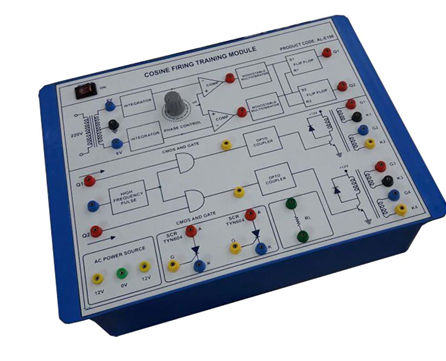
Experience unparalleled performance with the acclaimed COSINE FIRING TECHNIQUE CIRCUIT TRAINER, now available at the lowest price. This gilt-edged educational tool is expertly crafted for phase control training, utilizing the stellar Cosine Firing Technique to demonstrate cosine fired pulses clearly via LED output indication. Its advanced design incorporates on-board accessible components, silk-screened panel diagrams for intuitive operation, and built-in voltage protection. The robust ABS enclosure and high-grade PCB ensure enduring quality, while silent operation and a non-slip base elevate usability. Get it now for SCR and Triac triggering applications-ideal for laboratories and industry training centers. Exported, distributed, and supplied throughout India.
Unmatched Special Features and Versatile Commercial Application
The COSINE FIRING TECHNIQUE CIRCUIT TRAINER stands out with gilt-edged features like LED indication, multiple test points, accessible components, and a built-in safety fuse. Designed for ease of use, the silk-screened panel aids seamless operation. Its stellar build quality and silent operation make it indispensable for educational laboratories, industrial training centers, and engineering research. This trainer is ideal for hands-on learning environments where phase control and SCR/Triac applications are demonstrated effectively.
Secure Shipping and Unmatched Supply Capabilities Globally
We offer both secure and express shipping for the COSINE FIRING TECHNIQUE CIRCUIT TRAINER, catering to major export markets across Asia, Africa, and beyond. As a leading manufacturer and supplier, our supply ability meets high-volume institutional requirements. Flexible payment terms and competitive asking prices ensure easy procurement. Each unit is carefully packed to maintain pristine condition during transit, guaranteeing prompt and safe delivery to educational and commercial customers worldwide.
FAQ's of COSINE FIRING TECHNIQUE CIRCUIT TRAINER:
Q: How does the Cosine Firing Technique Circuit Trainer benefit phase control training?
A: This trainer demonstrates cosine firing techniques, providing hands-on experience with SCR and Triac triggering. LED output indication and test points allow trainees to monitor real-time circuit parameters, enhancing understanding and competency in phase control applications.
Q: What components and accessories are included with the circuit trainer?
A: Each unit comes equipped with accessible on-board electronic components, an AC power cord, and a detailed user manual. These features support effortless setup and convenient usage in both laboratory and industrial training environments.
Q: Where can the COSINE FIRING TECHNIQUE CIRCUIT TRAINER be used?
A: It is ideal for educational institutions, engineering colleges, industrial training centers, and research laboratories focused on phase control and power electronics.
Q: What safety features are provided in this circuit trainer?
A: The trainer includes a built-in fuse for effective voltage protection and a robust, non-slip base to ensure operational safety during use.
Q: How is the product shipped, and what payment terms are available?
A: We maintain secure and express shipping options, with flexible payment terms tailored for institutions and distributors. Each order is carefully packed and promptly dispatched to ensure timely, safe arrival.






 Send Inquiry


 Send Inquiry


 English
 Spanish
 French
 German
 Italian
 Chinese (Simplified)
 Japanese
 Korean
 Arabic
 Portuguese