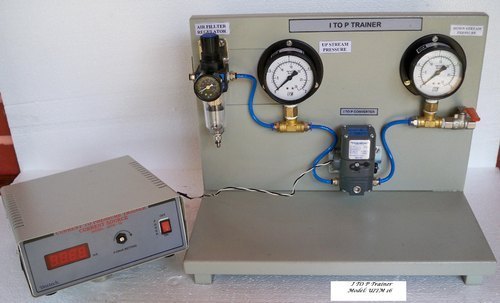
About Current To Pressure Measurement Trainer
Current To Pressure Measurement Trainer
| Brand |
Micro Technologies |
| Display Type |
31/2 digit LED display |
| Resolution |
0-1mA |
| I to P |
Input 4 to 20mA. Output 3 to 15 PSI |
| Air Pressure Required |
30 to 80 PSI continues. |
| Pressure Gauge |
Bourdon pressure gauge 30 PSI 4"-2 No's |
| Current o/p |
4 to 20mV Variable by a potentiometer. |
| Power Supply |
230V 50 Hz |
| Accessories Supplied |
Air Regulator with fitter. Necessary tubings and cable. |
| Optional |
Air compressor at extra cost.
|
Real-Time Measurement and SimulationThis trainer stands out by enabling both simulation and real-time measurement of current-to-pressure conversion. Students and professionals can observe live system responses and conduct performance assessments under varying test conditions, developing real-world instrumentation skills in a controlled environment.
Comprehensive Training FeaturesThe product is equipped with digital LED displays, pressure gauge, manual and automatic control, and a user-friendly front panel. The trainer also provides facilities for calibration, making it easy for trainees to practice process control and monitoring techniques safely and accurately.
Safe, Robust and Portable DesignEngineered for the demands of educational labs, the trainer incorporates overload and short circuit protection and uses PVC insulated wiring for operational safety. Its mild steel frame with powder coating and polycarbonate covers offer durability and portability, while the integrated pneumatic source and convenient instrumentation fittings add to ease of use.
FAQ's of Current To Pressure Measurement Trainer:
Q: How does the Current To Pressure Measurement Trainer function in an educational laboratory setting?
A: The trainer provides hands-on experience in current-to-pressure signal conversion by allowing users to simulate and measure control signals directly. Its integrated pneumatic supply, along with real-time digital indicators, helps students and trainees visualize and understand process instrumentation concepts effectively.
Q: What safety features are included to protect users and equipment?
A: This equipment includes overload and short circuit protection, ensuring safe operation during training. Additionally, PVC insulated internal wiring and a robust polycarbonate transparent cover help prevent electrical and mechanical hazards, making it suitable for educational environments.
Q: When is calibration required for the trainer and how can it be performed?
A: Calibration is recommended before first use, during regular maintenance cycles, or after prolonged periods of inactivity. The device offers an in-built calibration facility accessible via the front control panel, allowing accurate adjustments to maintain 1% of full-scale accuracy.
Q: Where should the trainer be installed for optimal performance?
A: The trainer is designed for bench-top mounting in a laboratory environment. Ensuring an ambient temperature between 10C and 45C and a stable AC mains power supply (230V, 50Hz) will provide optimal operational conditions for accurate measurements and safe usage.
Q: What is the process for connecting the trainer to instrumentation systems?
A: Standard instrumentation fittings provided with the equipment simplify connections to external process instruments. Users can easily link input current sources (4-20 mA) and monitor output pressures (3-15 psi) using the provided pressure gauge and digital displays.
Q: How does this trainer benefit process instrumentation training?
A: By combining simulation capabilities, real-time measurement, accurate calibration, and visual indicators, the trainer enables comprehensive process instrumentation training. It supports skill development in system troubleshooting, calibration procedures, and process control applications, making it valuable for both students and professionals.
Q: What materials and construction features ensure the durability of the trainer?
A: The equipment uses a mild steel frame with powder coating, a transparent polycarbonate cover, and stainless steel components. These materials are chosen for their strength and resistance to laboratory conditions, providing long-lasting durability and protection during frequent usage.






 Send Inquiry


 Send Inquiry


 English
 Spanish
 French
 German
 Italian
 Chinese (Simplified)
 Japanese
 Korean
 Arabic
 Portuguese