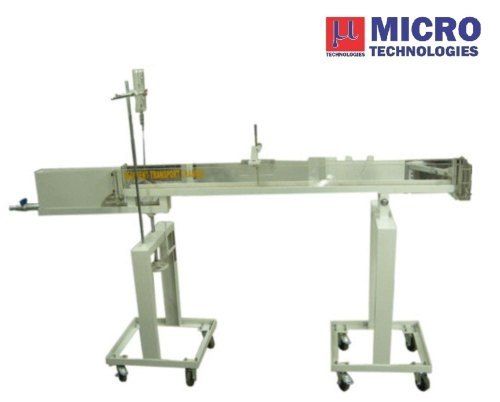
About Sediment Transport Demonstration Channel
Sediment Transport Demonstration Channel
| Brand |
MICROTECH |
| Material |
CHANNEL MADE OF ACRYLIC |
| Model Name/Number |
MT-STDC-101 |
| Size |
150x200x2000 |
| Color |
Blue /White/Gray |
| Automation Type |
MANUAL |
| Capacity |
Sump Tank 120L Capacity |
| Grade Standard |
MANUAL |
| Country of Origin |
Made in India |
Robust and Transparent DesignCrafted from 6 mm borosilicate glass and a powder-coated stainless steel frame, the channel provides exceptional durability and visibility. Its full-length observation windows on both sides allow comprehensive monitoring of sediment movement and water flow for enhanced learning and analysis.
Versatile Sediment and Flow ControlThe sediment feeders adjustable capacity enables realistic demonstrations of various sediment transport scenarios using supplied fine sand. With manually adjustable flow velocity up to 1 m/s and a recirculating water system, users can tailor experiments to explore different hydraulic conditions.
Complete Laboratory SolutionFeaturing plug and play installation, integrated drainage, and included laboratory accessories, the channel is ready for use out of the box. The transparent analog scale, sediment collection trays, and cleaning brush ensure precise measurements and easy maintenance for repeated classroom applications.
FAQs of Sediment Transport Demonstration Channel:
Q: How is the sediment introduced and controlled in the demonstration channel?
A: Sediment is introduced using the adjustable feeder, which holds up to 2 kg of fine sand. The feed rate can be manually regulated to simulate different transport conditions, ensuring accurate demonstrations and experiments.
Q: What types of experiments can be performed with this apparatus?
A: This channel allows demonstrations of sediment transport, open channel flow dynamics, bedform development, scouring, and deposition. The adjustable slope, transparent walls, and recirculating water facilitate observation of each process.
Q: When and where is this equipment typically used?
A: The apparatus is designed for use in educational laboratories, particularly in civil engineering and environmental science courses. Its bench-top format is ideal for university classrooms, training centers, and research labs.
Q: What is the process for measuring water depth and flow within the channel?
A: Water depth is measured using an analog scale with 1 mm accuracy. Flow is determined volumetrically via the integrated tank and measurement scale. Both provide precise and repeatable results for various experimental setups.
Q: What are the benefits of using borosilicate glass for the channel?
A: Borosilicate glass offers excellent visibility, chemical resistance, and temperature tolerance up to 150C. This ensures clear observation of sediment movement and long-term durability, even after repeated use and cleaning.
Q: How does the drainage and cleaning system operate?
A: A bottom outlet with an integrated valve efficiently drains the channel. After experiments, use the provided cleaning brush to easily remove residual sediment and maintain the transparent walls for optimal visibility.
Q: What safety and operational features are included?
A: The channel operates at a quiet noise level below 60 dB and a safe 220V AC supply. With powder-coated frame, corrosion-resistant materials, and full safety instructions provided, it ensures safe and reliable operation in any lab environment.






 Send Inquiry


 Send Inquiry


 English
 Spanish
 French
 German
 Italian
 Chinese (Simplified)
 Japanese
 Korean
 Arabic
 Portuguese