About Law of Conservation of Mass (Collision in 2-D Apparatus)
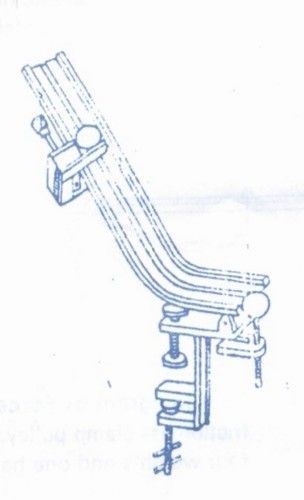
Law of Conservation of Mass (Collision in 2-D Apparatus)Theapparatus consists of an attractive and durable curved track grooved in themiddle on which tolls a steel ball, can be clamped on the table, A levelingscrew is provided under the base to make the lower and of track horizontal. Thetrack carries an adjustable automatic release system to permit setting of theball at exactly the same starting point for multiple runs. An adjustablesupport attached to base holds the Secord ball directly in the path of thefirst, or displaced from the path to cause the collision to occur at differentangles and at different distance from the end of the track .
Precision Engineering for Accurate ResultsBuilt with high-grade aluminum and steel, this collision apparatus offers exceptional durability and accuracy (0.5 mm), making it reliable for repeated educational use. The powder-coated, rust-resistant finish ensures longevity, while precision rulers allow for detailed measurement during experiments.
Child-Safe and Internationally CompliantDesigned with safety in mind, the apparatus utilizes non-toxic, child-safe materials. It not only meets but exceeds international educational standards, making it suitable for schools and institutes globally. The packaged foam and cardboard box further guarantee safe transit and storage.
Easy Setup and Versatile ApplicationRequiring no external power, the manual setup allows for immediate use in any classroom or lab environment within temperatures ranging from 0C to 50C. Simple assembly and included instructions mean teachers and students can quickly prepare and conduct impactful experiments.
FAQ's of Law of Conservation of Mass (Collision in 2-D Apparatus):
Q: How does the Law of Conservation of Mass (Collision in 2-D Apparatus) demonstrate collision principles in physics?
A: The apparatus uses two high-quality collision balls and a precision platform to simulate two-dimensional elastic and inelastic collisions. By measuring the positions and trajectories before and after impact, students observe the conservation of mass and momentum in real time.
Q: What accessories are included with the apparatus, and how are they used during experiments?
A: This set includes collision balls, a sturdy platform, rulers for precise measurement, calibration tools, and a comprehensive instruction manual. These components guide students in setting up, conducting, and accurately recording the outcome of collision experiments.
Q: Where is this collision apparatus best utilized for educational purposes?
A: It is ideal for secondary schools, colleges, universities, and other educational laboratories focused on physics. Its manual operation and portability make it suitable for tabletop use in a range of learning environments.
Q: When should calibration be performed on the apparatus, and why is it necessary?
A: Calibration should be performed before initial use and periodically thereafter to ensure the measurement scale and collision mechanism remain precise. Accurate calibration is crucial for reliable, reproducible experimental results.
Q: What is the process for assembling and operating the apparatus?
A: Assembly is straightforward-simply follow the step-by-step instruction manual to set up the platform, attach collision balls, and adjust rulers. Operation is completely manual: users release balls from set heights and record their motions post-collision.
Q: How does using this apparatus benefit physics education?
A: The apparatus provides hands-on experience with fundamental physics concepts. By enabling direct observation of the law of conservation of mass and momentum, students gain clearer conceptual understanding and practical measurement skills.








 Send Inquiry


 Send Inquiry


 English
 Spanish
 French
 German
 Italian
 Chinese (Simplified)
 Japanese
 Korean
 Arabic
 Portuguese