

Call us now
08045803621
Call us now
08045803621
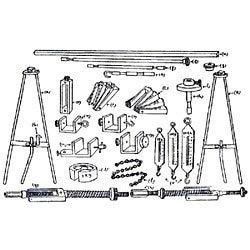
1. (1) (2) (3) (4) (5) (6) (7) (8) (9) (10) (11) (12) (13) (14) North Light Roof Truss.
Details of Accessories :-
(a) Stand and cross bars(4 bars & 8 stands) 4 Sets.
(b) Brackets fitted withstands. 4 only.
(c) Hinges(different) 22 only.
(d) Hinge HolderHooks. 8 only.
(e) Cantilever rod withtop caps. 2 only.
(f) Member rods (sizesmarked) 37 only.
(g) Cap Screws(extra). 6 only.
(h) Weight hanger withplatform. 8 only.
(i) Weight platformsextra. 2 only.
(j) Slotted weights1kg. 10only.
(k) Spring balances (2 of20kg. 2 of 10kg. 4 of 5kg. 8 only.
(l) Chains short andlong. 6 only.
(m) Boss Brackets. 2 only.
(n) Ring Brackets. 5 only.
(o) Hook brackets. 4 only.
(p) Pulley brackets. 3 only.
(q) Member balances toindicate tensile force 3only.
(r) Member balances toindicate compressive force. 3 only.
All parts are interchangeable so that thedifferent frame works can be assembled with same components. All the components(except cross bars and stands) are supplied in a polished wooden box. Completewith assemblies drawings leaflet.

Price:
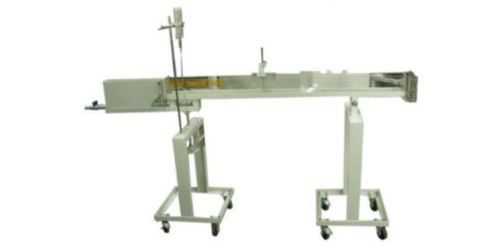
Function : Demonstrates principles of sediment transport, flow visualization, and bed formation
Machine Type : Flow Channel Apparatus
Control System : Integrated Flow and Sediment Control System
Type : Sediment Transport Demonstration Channel
Material : Transparent Acrylic and Stainless Steel
Accuracy : High measurement accuracy for velocity and sediment displacement
Function : Measurement of personal horsepower generated by an individual
Machine Type : Mechanical Testing Apparatus
Control System : Mechanical brake and pulley arrangement
Type : Personal Horse Power Apparatus
Material : Mild steel frame with steel components and cast iron weights
Accuracy : 2%
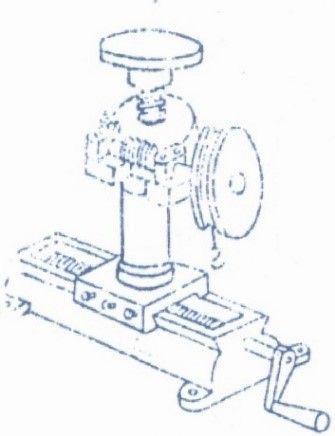
Function : Lifting, Lowering and Precise Positioning
Machine Type : Compound Screw Jack
Control System : Rotary Screw Mechanism
Type : Compound Screw Jack With Transverse Motion
Material : High Grade Mild Steel / Alloy Steel
Accuracy : 0.05 mm
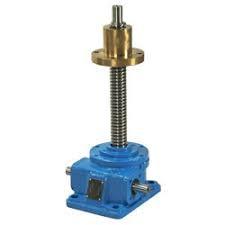
Function : To determine and study the efficiency of screw mechanisms
Machine Type : Bench Top Apparatus
Control System : Handoperated mechanical control
Type : Educational Laboratory Equipment
Material : Mild Steel (MS), Stainless Steel (SS) components
Accuracy : 1%



 Send Inquiry


 Send Inquiry


 English
 Spanish
 French
 German
 Italian
 Chinese (Simplified)
 Japanese
 Korean
 Arabic
 Portuguese