About Universal Force Table
Universal Force Table
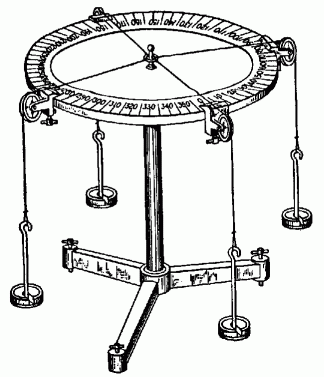
Forexperimentally verifying the laws of triangle. Parallelogram and polygon offorces. Comprising of a circular 40 cm. diameter aluminum disc, graduated into360 degrees. Complete with levelling screws, clamping device to fix the tableat any desired angle, five sliding clamp pulleys, central ring, string and fivesets of iron nickelled slotted weights, each set containing nine weights andone hanger of 50gms, each.
Precision and Versatility in ExperimentationThe Universal Force Table stands out with its high-accuracy graduated circle and a robust, rotatable platform. Designed for manual operation, it accommodates up to four pulleys and a variety of weight combinations, making it suitable for a broad array of vector resolution and addition experiments. Its sturdy construction ensures safety and reliability for repeated educational use.
Built for Stability and Long-Term UseWith anti-skid rubber feet and a powder-coated finish, the table maintains firm placement during intensive experiments. The rust-resistant, easy-to-clean aluminum alloy platform complemented by stainless steel accessories ensures sustained durability, while adjustable leveling screws help achieve optimal calibration in any laboratory setting.
FAQs of Universal Force Table:
Q: How is the Universal Force Table primarily used in a physics laboratory?
A: The Universal Force Table is utilized to visually and experimentally demonstrate concepts of vector addition and resolution. Students attach weights to pulleys and observe how force vectors interact, making it an invaluable tool for practical learning in classical mechanics.
Q: What is the process of setting up the Universal Force Table for an experiment?
A: To set up, level the table using the three-point leveling screws and attach the required number of pulleys using the rigid clamps. Place the provided weights on the nylon strings and adjust the angles using the graduated scale for precise vector measurements.
Q: When should additional pulleys be used on the table?
A: Additional pulleys should be added when experiments require the demonstration or calculation of more than three force vectors. The table can be expanded to accommodate up to four pulleys, allowing for greater experimental versatility.
Q: Where can the Universal Force Table be effectively installed?
A: This apparatus is best installed in educational laboratories, schools, colleges, universities, or any learning space focused on physics. Its compact size and anti-skid feet make it suitable for flat, stable surfaces in a controlled environment.
Q: What are the benefits of using rust-resistant, powder-coated components?
A: Rust-resistant, powder-coated surfaces ensure long-lasting durability and minimal maintenance. This helps the force table retain its accuracy and appearance over years of frequent use, reducing the need for frequent repairs or replacements.
Q: How does the anti-skid mounting base contribute to experimentation?
A: The anti-skid rubber feet stabilize the apparatus, preventing unwanted movement during experiments. This promotes accurate data collection and enhances safety by minimizing the risk of accidental slips.








 Send Inquiry


 Send Inquiry


 English
 Spanish
 French
 German
 Italian
 Chinese (Simplified)
 Japanese
 Korean
 Arabic
 Portuguese